
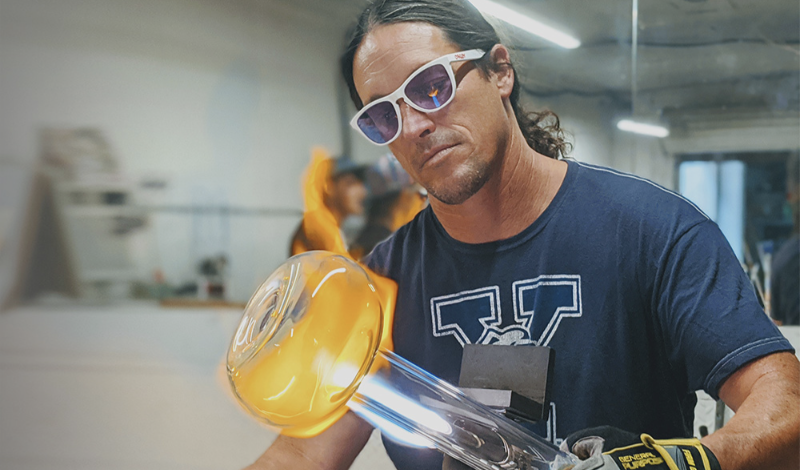
This year at Hall of Flowers we met Jason Harris, the glass artist and co-founder of Jerome Baker Designs. In The Green Room, Harris takes us back to the early ’90s Grateful Dead scene, when a glass pipe on your belt was a fashion statement and the bowl marks on your shirt were proof you’d worn it well. He tells us what Bob Snodgrass taught him at the torch, why Operation Pipe Dreams made him walk away from his business, and how one of his bongs managed to upstage a Basquiat and a Warhol.
High Herstory: How did you first find your way into glassblowing and cannabis culture? Was this always part of the master plan, or did life take a wonderfully unexpected turn?
Jason Harris: I originally got into glassblowing because I was interested in it as an art form. I wanted to carve out a name for myself in the art world and make a living selling my glass art. I never expected it to become so intertwined with cannabis. But cannabis and glass naturally go hand in hand, and as legalization has taken longer than anyone anticipated, I've found myself increasingly drawn into the activism side of the movement, too.
HH: Jerome Baker Designs came out of the Grateful Dead era and the underground glass scene of the early '90s. Take us back to those days. What was the culture like, and what's one story from that era that still feels almost too outrageous to be true?
JH: Back then, having a big glass pipe was a major part of the culture. People would carry these enormous pipes in pouches attached to their belts and show them off wherever they went. It was almost a badge of honor. And here's the really ridiculous part: after smoking, people would wipe the bowl clean on their shirts. The person with the most bowl marks on their shirt was considered the coolest kid!
Looking back, what's incredible is how that underground scene evolved into a global glass movement. What started with a relatively small community of artists and pipe makers eventually became an international phenomenon in glass production and distribution.
HH: You apprenticed under legendary glass artist Bob Snodgrass. What's the most important lesson he taught you, either about glass, creativity, or life?
JH: More than anything, Bob taught me how to be a good person and a stand-up human being. One of his favorite sayings was, "Don't wash your hands with your sandwich." It was his way of reminding people to take care of their tools, their work, and themselves. It sounds simple, but it's really about respecting what you do and how you do it. That's something I've carried with me throughout my career.
HH: Your work has always blurred the line between functional glass and fine art. If you could create a dream piece for any artist, musician, or historical figure, living or dead, who would it be, and what would you make?
JH: I'd love to create something for a lawmaker, politician, or even a sitting president that could help change hearts and minds about cannabis. Maybe a set of scales of justice that makes a statement about legalization.
Some of the most impactful pieces I've made have been for people who don't even consume cannabis. When you put an elaborate piece of glass in someone's home, particularly alongside other fine art, it challenges people's perceptions. I once had a piece displayed in a friend's home alongside works by Basquiat and Warhol. People would walk into the room and immediately ask, "Is that a bong?" Sometimes it got more attention than the paintings!
That's the power of art. I'd love to keep creating pieces that make people reconsider their attitudes about cannabis.
HH: In 2003, Operation Pipe Dreams brought your business to a halt. Looking back, what did that experience teach you about freedom, resilience, and the absurdities of cannabis prohibition?
JH: Honestly, it taught me that we're not truly free unless we're willing to stand up for what we believe in. At the time, the experience scared me enough that I shut down the business and walked away. Looking back, knowing what I know now, I wish I had kept it alive and fought for it.
The whole situation really exposed the absurdity of cannabis prohibition. It felt like authorities could selectively decide who they wanted to target while leaving others alone. The media attention and late-night comedy surrounding the operation also brought just how ridiculous the situation was into the public conversation.
HH: You've created pieces for some legendary names in music and entertainment. Is there a particularly memorable commission, celebrity encounter, or behind-the-scenes story that still makes you laugh?
JH: One of the most meaningful experiences was creating a piece called the Sphere of Consciousness for the Dalai Lama. When we moved to Maui, we wanted to introduce ourselves to the community in a big way. We learned he was coming to the island, arranged a private meeting, and had the opportunity to present him with the piece. That was pretty incredible.
But one of the funniest experiences was hanging out with Snoop Dogg backstage in Portland around 1998. Right before his show, everyone was being ushered out of the backstage area. A friend and I decided we weren't going anywhere. We ended up staying, holding hands with Snoop and his crew during their pre-show prayer, and then walking out onstage with him.
We spent the show at the back of the stage packing bong hits and rolling joints. Every so often, Snoop would come back, take a hit, and head right back to perform. It was an unforgettable night!
HH: Jerome Baker Designs has become an iconic name in functional glass. What do you think makes a piece unmistakably Jerome Baker, and how has your artistic vision evolved over the decades?
JH: I think our fuming techniques and the intentional placement of the artwork are what make a piece unmistakably Jerome Baker. Fuming is a process where we use tiny amounts of precious metals, like gold, silver, or copper, and heat them in a flame until they vaporize and create a coating on the glass. That produces unique colors, textures, and effects. It's a technique Bob Snodgrass helped discover, and one we've continued to develop over the years.
My artistic vision has evolved through experimenting with different materials and techniques. But the foundation of what I do hasn't changed. There's also a bigger purpose behind it. While cannabis remains illegal, there's still an important movement that I'm part of.
Even if legalization happened tomorrow, I wouldn't stop making these pieces. They're more than objects. They're instruments that people use to enhance their lives, find inspiration, and sometimes even get well. In many ways, they're a sacrament or a tradition. It's like making musical instruments. You're creating something that brings people happiness, not just another object.
HH: Cannabis has gone from underground counterculture to corporate boardrooms. What's something the modern cannabis industry desperately needs to remember about the people who built its culture?
JH: There are a lot of people who paved the road we're all traveling on today, and we shouldn't forget them. People like Robert Connell Clarke, Ben and Alan Dronkers, and Eagle Bill Amato were motivated by something much bigger than making money or becoming the biggest name in the industry.
They were passionate about sharing something they had discovered. They believed in the magic of the plant and wanted other people to experience it, too.
I think that's something the modern industry needs to remember. We shouldn't lose sight of what motivated the people who built this culture in the first place. If we can hold on to that same passion and respect for the plant, we'll have a much stronger foundation for the future.
In Conclusion:
Of all the pieces Jason Harris has made, we keep thinking about the one he’s still dreaming up: a set of scales of justice for a lawmaker. There’s something deliciously cheeky about asking the people who write cannabis laws to spend a little time with the art those laws once drove underground. And in an industry full of people eager to tell you what’s next, we’re glad we crossed paths with someone who remembers what came before, bowl marks and all. You can check out Jerome Baker Designs here.